 |
 |
 |
Dactylosiphon bullosus
Sea Rubber
17 May 2026
Willow Point North, Discovery Passage (south end), British Columbia, Canada.
Tide: 0.5 foot low at 12:11 pm PDT (measured at Campbell River Tidal Station)
Weather: Sunny, wind E 10 to 15 km/hour, sea rippled, humidity 60%, 15˚ C.
Moon: Waxing Crescent (1 day, 1.4%), Next phase, First Quarter, 23 May 2026 at 4:10am PDT; Previous Phase, New Moon, 16 May 2026 at 1:01pm PDT.
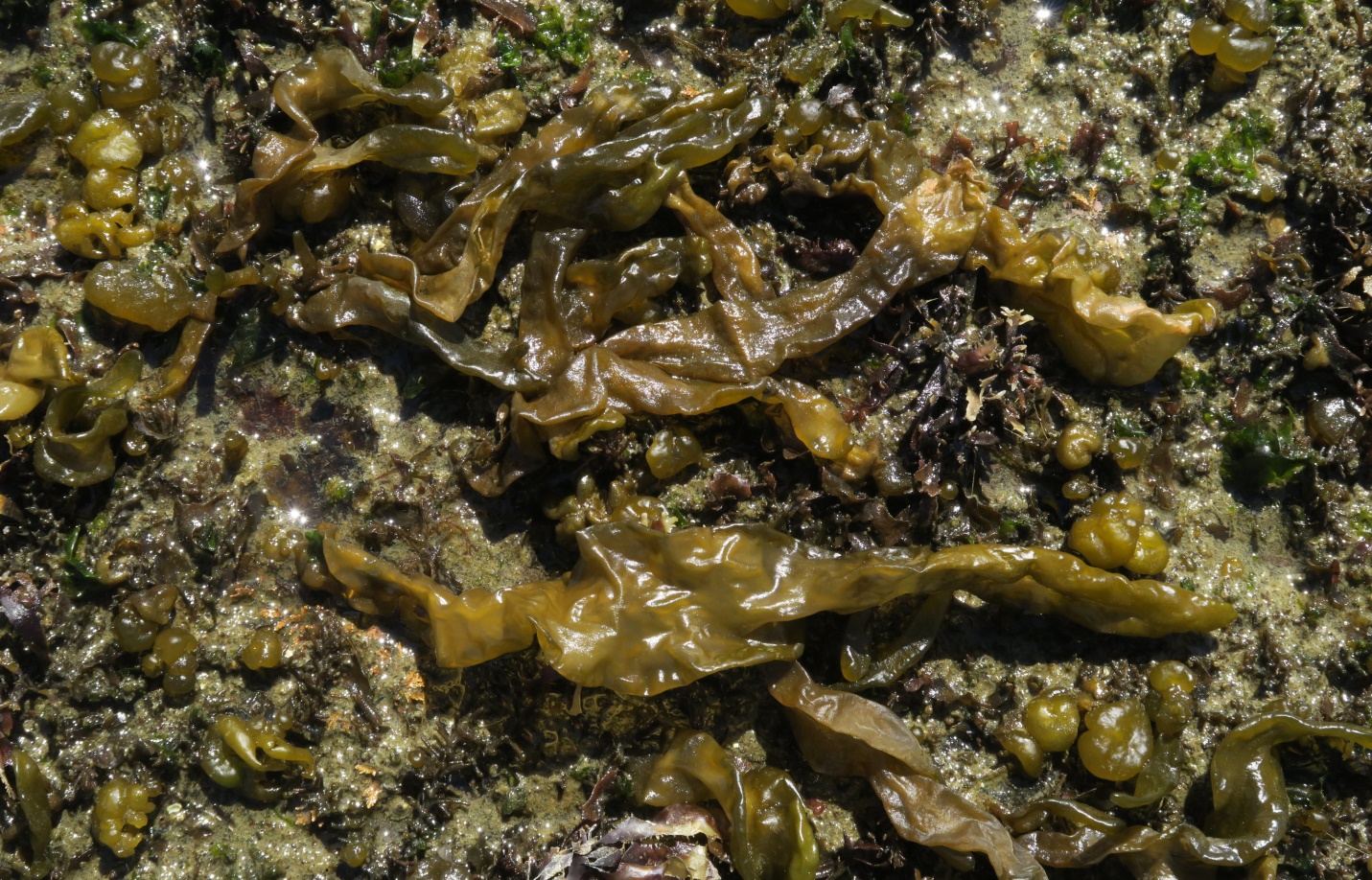
Figure 1: Growing here on a sandstone shelf shore along the edge of Discovery Passage there are numerous sac-like brown algae of at least three different species. In this picture the collection of larger rather contorted looking ones are Dactylosiphon bullusos. Willow Point North, Discovery Passage (south end), B.C., Canada. May 17, 2026. Photo ID 27869 ©Seaweedwhisperings.com
Person 1:
Identity somewhat confused...
Epilithic..., or epiphytic...?
Checking to find out what the shape of the base and holdfast is.
None of these features (useful to distinguish the species) were obvious without a very close look.
Dactylosiphon bullosus is overshadowed by more conspicuous seaweeds. That does not mean it was covered up, it’s just Dactylosiphon was not as obvious as its neighbors.
Feeling neglected. Feeling unwanted. Grows amongst other sac-like seaweeds, mainly Leathesia marina.
Is the feeling of neglect and being unwanted self-imposed?
Is being unattractive self-generated?
Wondering if it likes to confuse as a distraction; others can’t get to know them due to this confusion.
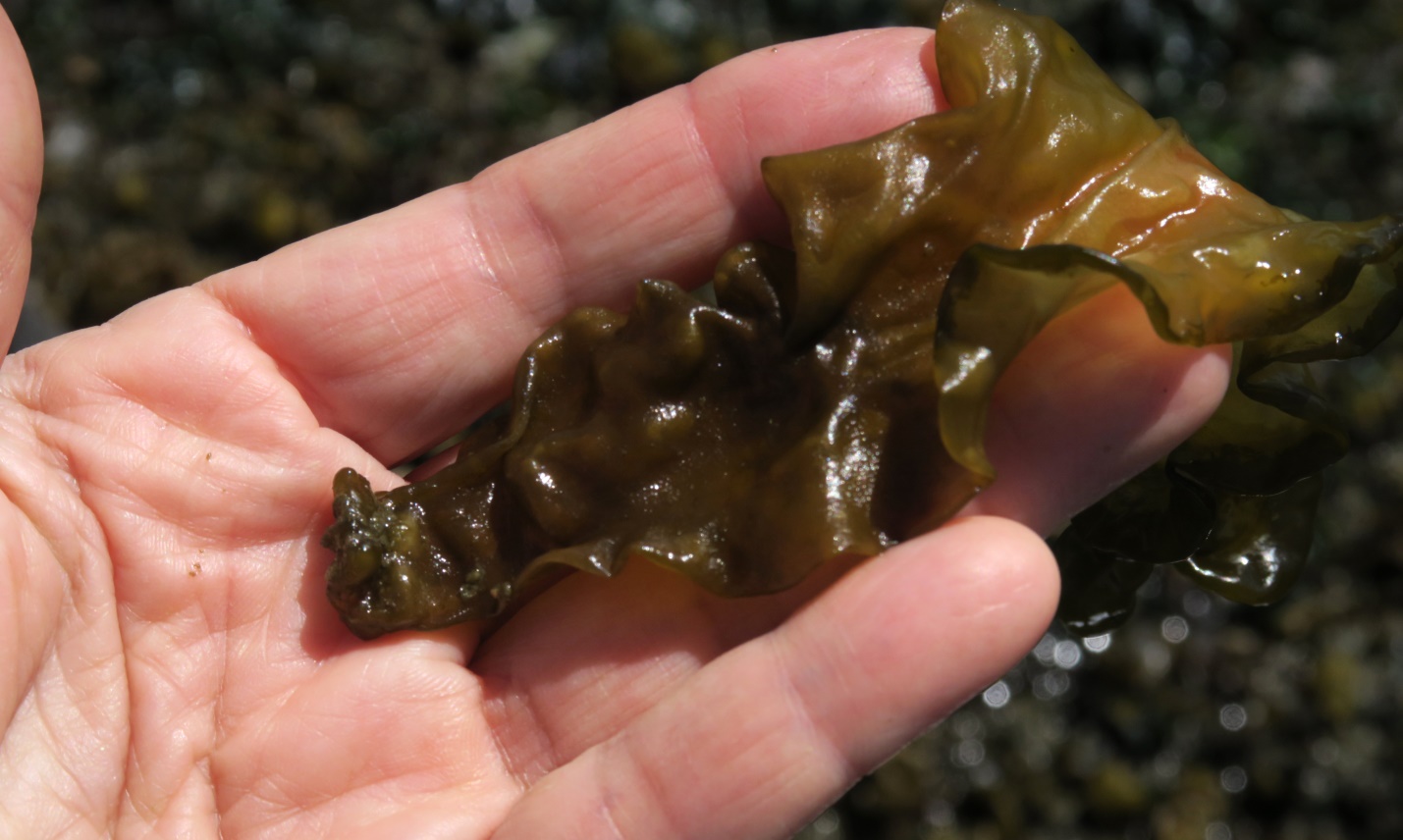
Figure 2: This individual let go of the substrate more easily than expected while being examined. In fact some of the ‘sea rubbers’ were quite firmly attached and as for a few others..., well, not quite so much. Held in hand the lumpy base and holdfast area is plain to see. Willow Point North, Discovery Passage (south end), B.C., Canada. May 17, 2026. Photo ID 27870 ©Seaweedwhisperings.com
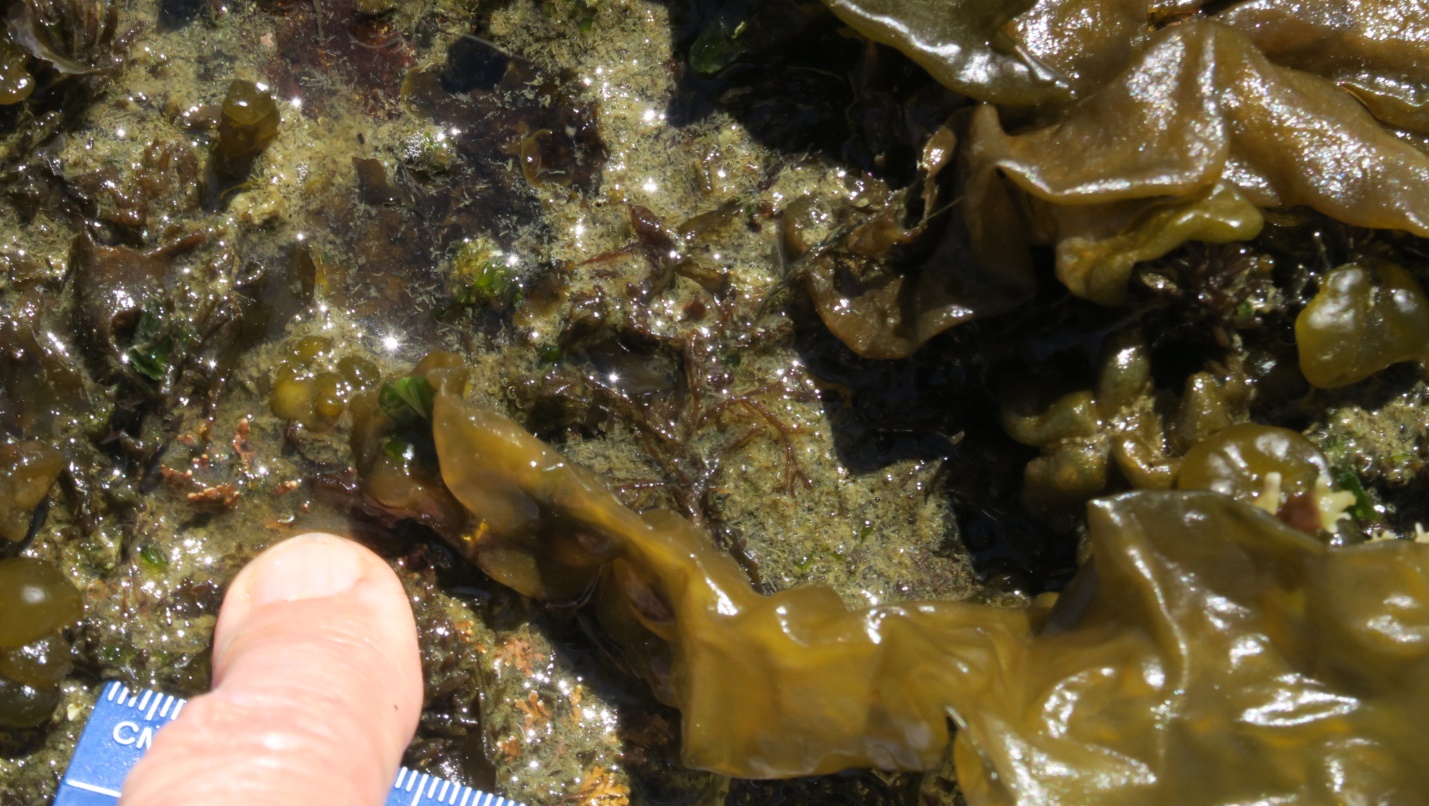
Figure 3: The finger in this photograph points to the lumpy point of attachment for one Dactylosiphon bullusos. It merges with the rock in a rather simple way, and looks almost like a lump of adhesive has been liberally administered. There is no stipe in this seaweed’s morphology and this seems to limit how the body of the thallus might move in water. Willow Point North, Discovery Passage (south end), B.C., Canada. May 17, 2026. Photo ID 27871 ©Seaweedwhisperings.com
Person 2:
You are growing in an area where there are numerous Leathesia marina algae and also many Colpomenia peregrina. Those other two similarly yellowish colored sac-like seaweeds somehow draw my eye much more than you do Dactylosiphon bullosus.
Do you like to not draw attention? Why?
Once I do see you, Dactylosiphon, I find many more of you in the general area and I also find that I’m not all that interested to look closely at you. It’s almost as if I’m getting the message from you to just skip on over any closer viewing of you.
Your color, a yellowish brown with some tints of green in it, is more of a ‘background’ color. It blends in and certainly does not stand out like some of the bold red seaweeds nearby or even the bright green ones.
Your texture is contorted and a bit twisted.
In what look to be individuals in the prime of Dactylosiphon health, the thallus feels crisp and somewhat thick or almost succulent. The sides of your cylindrical form do not want to roll over themselves like the soft finger of a glove or a condom might do (note: the common name of this seaweed is ‘sea rubber’) but remain quite stubbornly in whatever somewhat flattened and contorted position they have chosen for themselves. This stubborn, crisp and set-in-place aspect is so strong that it feels that if I tried to force the cylinder into more of an expanded elongated balloon shape (inflate it) the flesh might crack or break, and I am compelled to not disturb it, to not experiment and see what happens. Again this seaweed emits an energy that strongly says “leave me be”.
You have an unusual base / holdfast, Dactylosiphon – it is contorted and lumpy and looks as if it has been “stuck” onto the substrate by a careless application of a glue gun’s melted adhesive.
In fact, the whole of you looks somewhat ‘melted’; like something that may have once been more defined and possibly refined but now has melted and slumped and let go of any attempt to maintain a certain posture or look. You don’t even look like you’re built to enjoy moving in water – floating a bit, sure, but not playing in the ocean swells and currents.
You come close to looking like something that has served its purpose and has been discarded or abandoned. I wonder if this somewhat derelict trait is limited to your physical qualities. So far as your inner self is concerned are you simply far more engaged with things that have very little to do with the physical and external? Is this why you have abandoned attention to that aspect; you simply don’t see it as a priority?
What, then, is important to you, Dactylosiphon bullosus? I spent some time trying to understand this and I felt you were keeping that very private. I almost sensed that you were a bit surprised that I’d noticed you well enough to ask such a question and you didn’t seem offended to be asked, but you also weren’t willing or able to give me your answer.
There were places that I found you growing in groups. It didn’t seem like the groups of thalli were happy to be together, and those growing in groupings didn’t seem more prosperous or more successful than those that were not. It was almost as if the clumping together of you was sometimes imposed by some outside force and at other times it was not.
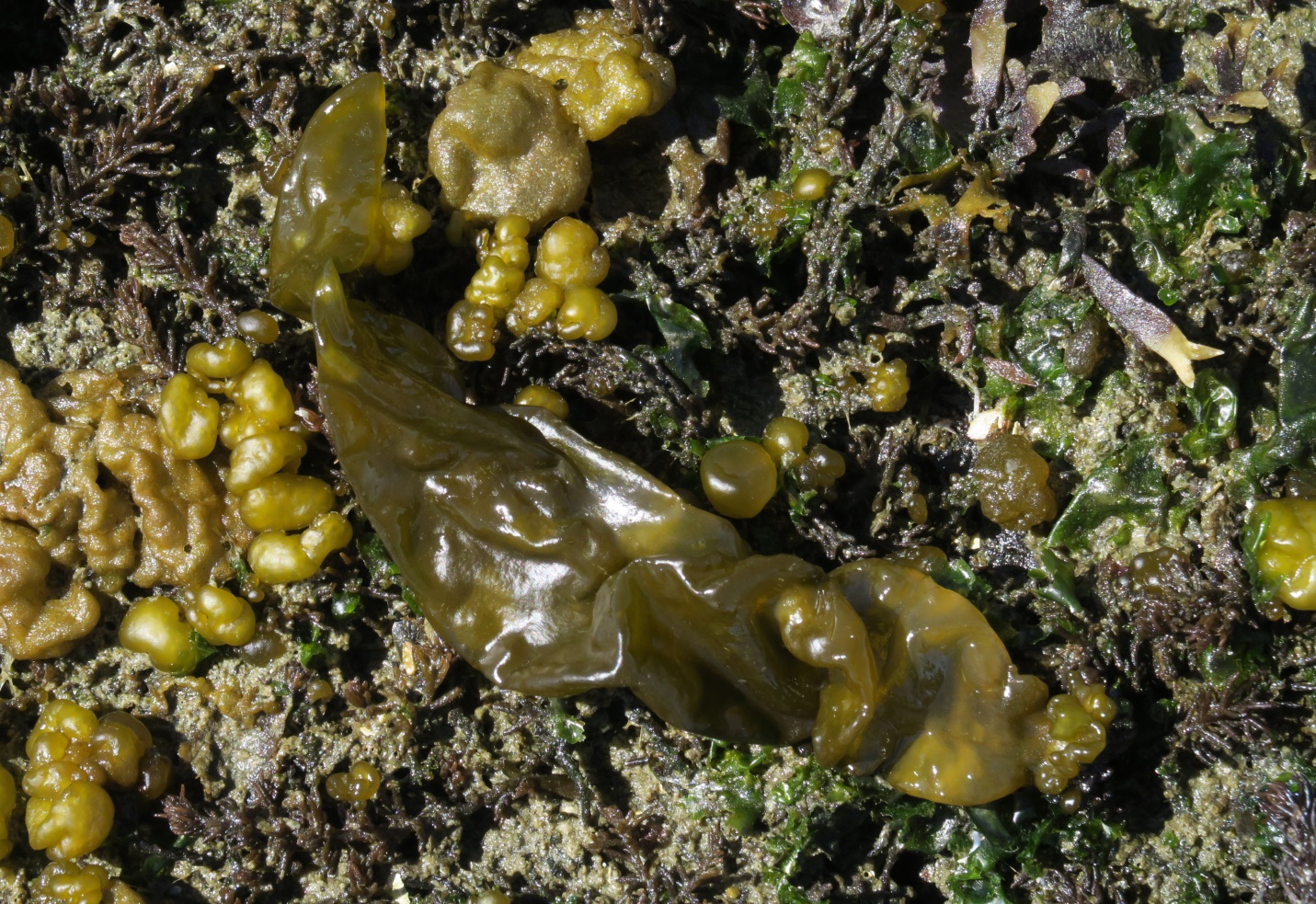
Figure 4: This sea rubber individual looks to be in prime condition. The other yellowish lumpy sac-like seaweeds also in the picture are Leathesia marina. L. marina can tolerate positions higher in the intertidal zone than Dactylosiphon bullosus, but down closer to the margin of the low subtidal and subtidal we found many more Dactylosiphon bulluosus algae. Willow Point North, Discovery Passage (south end), B.C., Canada. May 17, 2026. Photo ID 27872 ©Seaweedwhisperings.com
Person 3:
Within the energy of Dactylosiphon bullosus there is what feels like a contradiction.
It doesn’t appear to want to be noticed by the casual observer and yet … its inner energy feels almost resentful that it is neglected and not appreciated. Is the observer intuitively supposed to know what Dactylosiphon bullosus wants and offer that?
This contradiction continued in the absence of a strong preference for growing in a group or being more isolated. Neither seemed to be a favoured position. It’s as if Dactylosiphon bullosus is at times uncertain of what it wants and at other times exhibits an almost stubborn refusal to alter how they interact with the world.
Does Dactylosiphon bullosus want the world to appreciate them as they are without the need to meet the expectations of others?
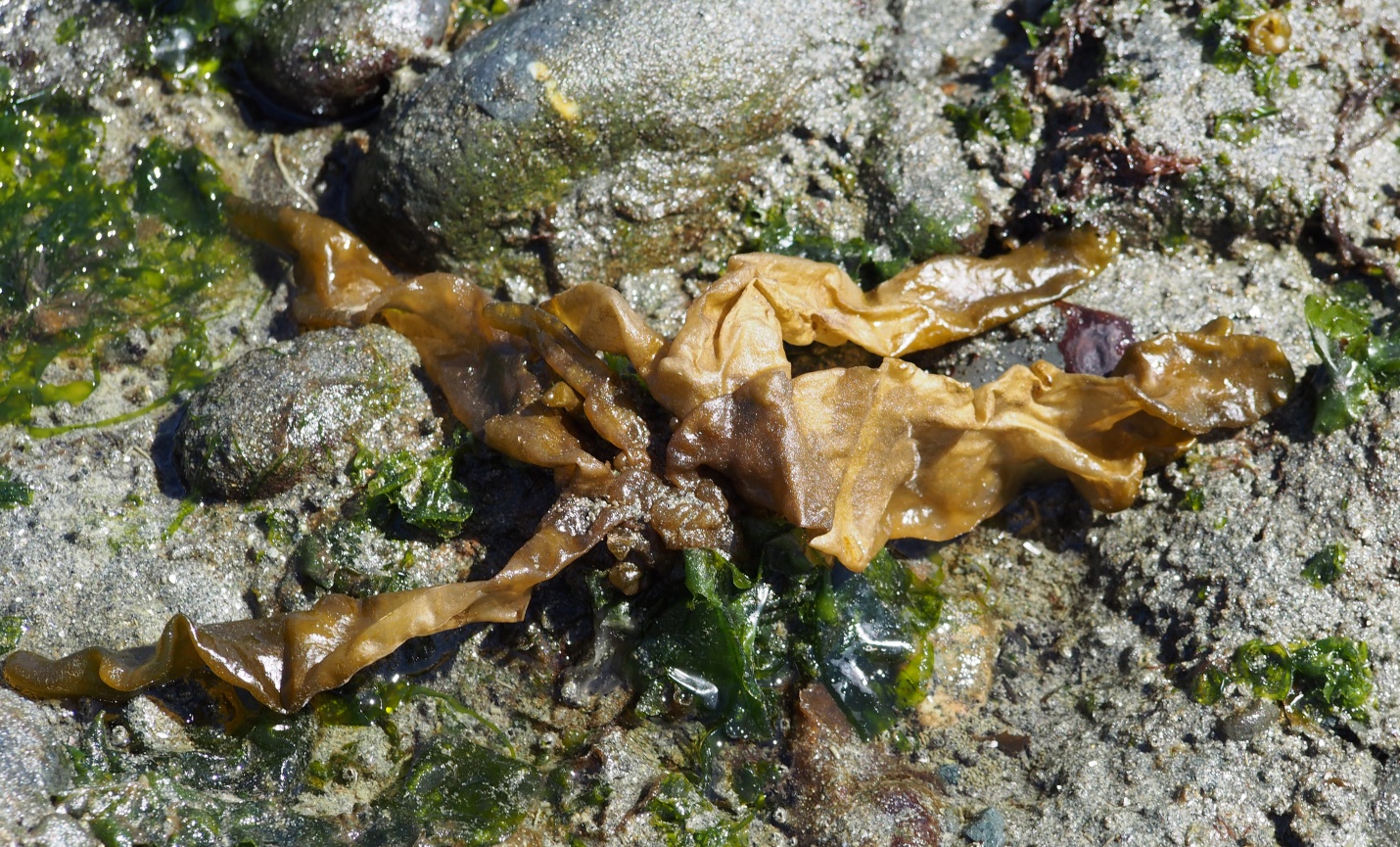
Figure 5: This grouping of Dactylosiphon bullosus thalli are all arising from, and flopping this way and that, from a central rather large clumpy holdfast base. Some of the cylindrical blades for some reason are more desiccated – possibly they are older and have suffered some kind of injury. A bit of sand coats things in the area and possibly causes some minor abrasion. Willow Point North, Discovery Passage (south end), B.C., Canada. May 17, 2026. Photo ID 27873 ©Seaweedwhisperings.com
Discussion:
Dactylosiphon bullosus lives out in plain view but is also not conspicuous, is easily overshadowed. Part of how this happens is that this seaweed is not ‘attractive’ in any of the more typical ways that many other seaweeds can be. Person 1 wondered if being unattractive is self-generated. Person 2 felt that physical concerns were simply not of importance to Dactylosiphon. Person 3 experienced this as an internal conflict between wanting recognition at some times and wanting to be unobserved in others. Another possibility is that being unattractive gives Dactylosiphon bullosus the privacy and lack of interruption that it seems to prize in life.
Being out in the open is important in this scenario; it means that Dactylosiphon does not have to compete for sunlight and nutrients from beneath a canopy or amongst other larger seaweeds. It feels like Dactylosiphon itself is done with striving and competition; it lives where physical needs can be met but also where securing those needs does not consume all of their creative energy. There is a different focus for this seaweed and it is clear that where this shows up is with internal aspects – not external.
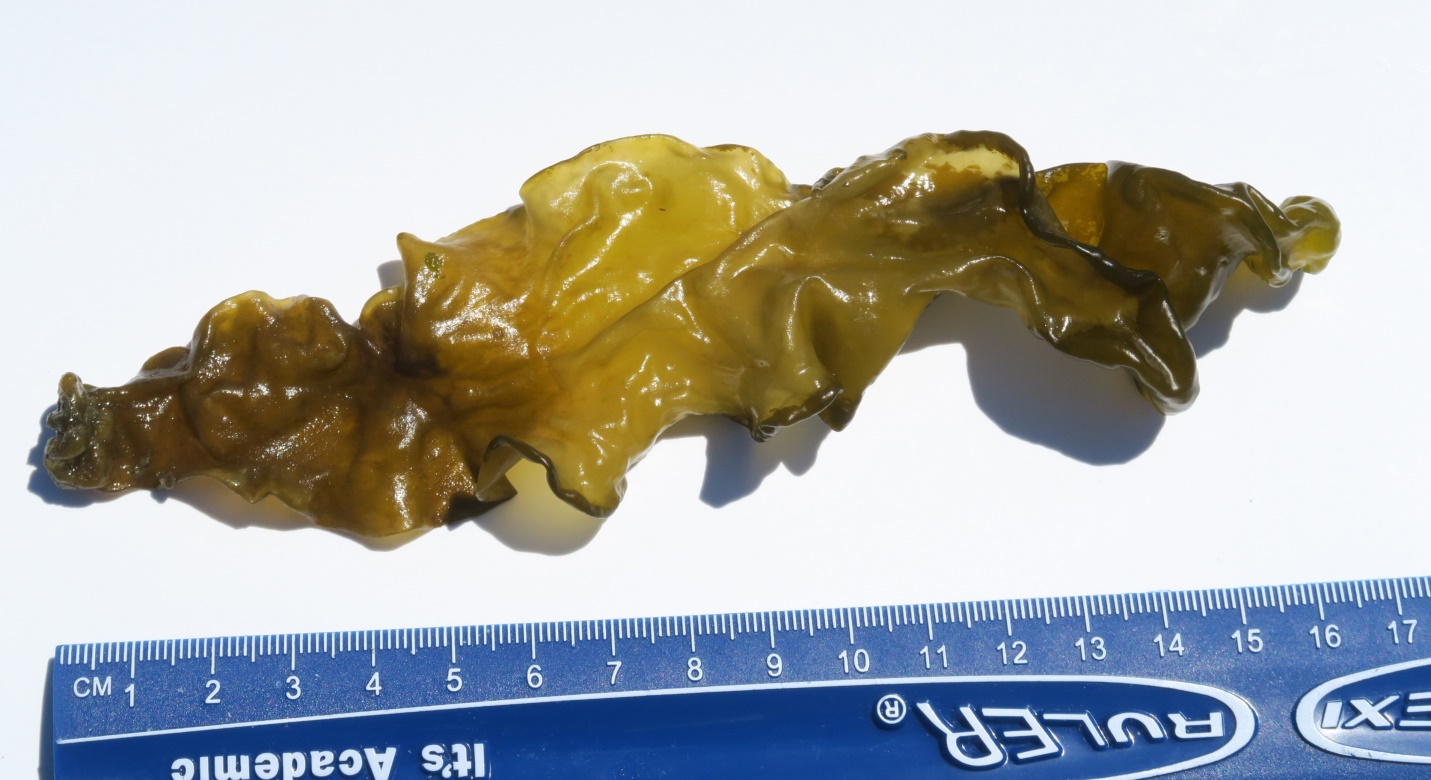
Figure 6: This individual has grown to nearly the full average length of 20 cm. With a plain background it is easier to see the contortions of the cylindrical thallus. In situ, this blade can be hard to really see, and the contortions even serve to break up the ‘profile’ and make it less distinct being one whole thallus. It can look like scattered bits of golden brown something or other! Willow Point North, Discovery Passage (south end), B.C., Canada. May 17, 2026. Photo ID 27874 ©Seaweedwhisperings.com
Biology & Natural History Information:
Description:
Thallus is a cylindrical, yellowish-brown contorted sac that often grows in small clusters. It arises from an irregular cushion-like base and holdfast. The cylinders end with a rounded point at their distal end and are often flattened. Average maximum height is 20cm (8 inches).
Habitat:
This annual brown alga is found in the low intertidal zone growing on rock. It prefers semi-protected to semi-exposed habitats.
North Pacific Distribution:
Unalaska Island, Alaska, to central California; China; Korea; Japan.
Remarks:
Classification:
Empire: Eukaryota
Kingdom: Chromista
Phylum: Heterokontophyta
Subphylum: Orchrophytina
Class: Phaeophyceae
Subclass: Fucophycidae
Order: Ectocarpales
Family: Scytosiphonaceae
Tribe: Scytosiphoneae
Genus: Dactylosiphon
Species: Dactylosiphon bullosus (D.A.Saunders) Santiañez, K.M.Lee, S.M.Boo & Kogame 2018
Former name(s):
Homotypic synonyms: Scytosiphon bullosus D.A.Saunders 1898; Colpomenia bullosa (D.A.Saunders) Yamada 1948.
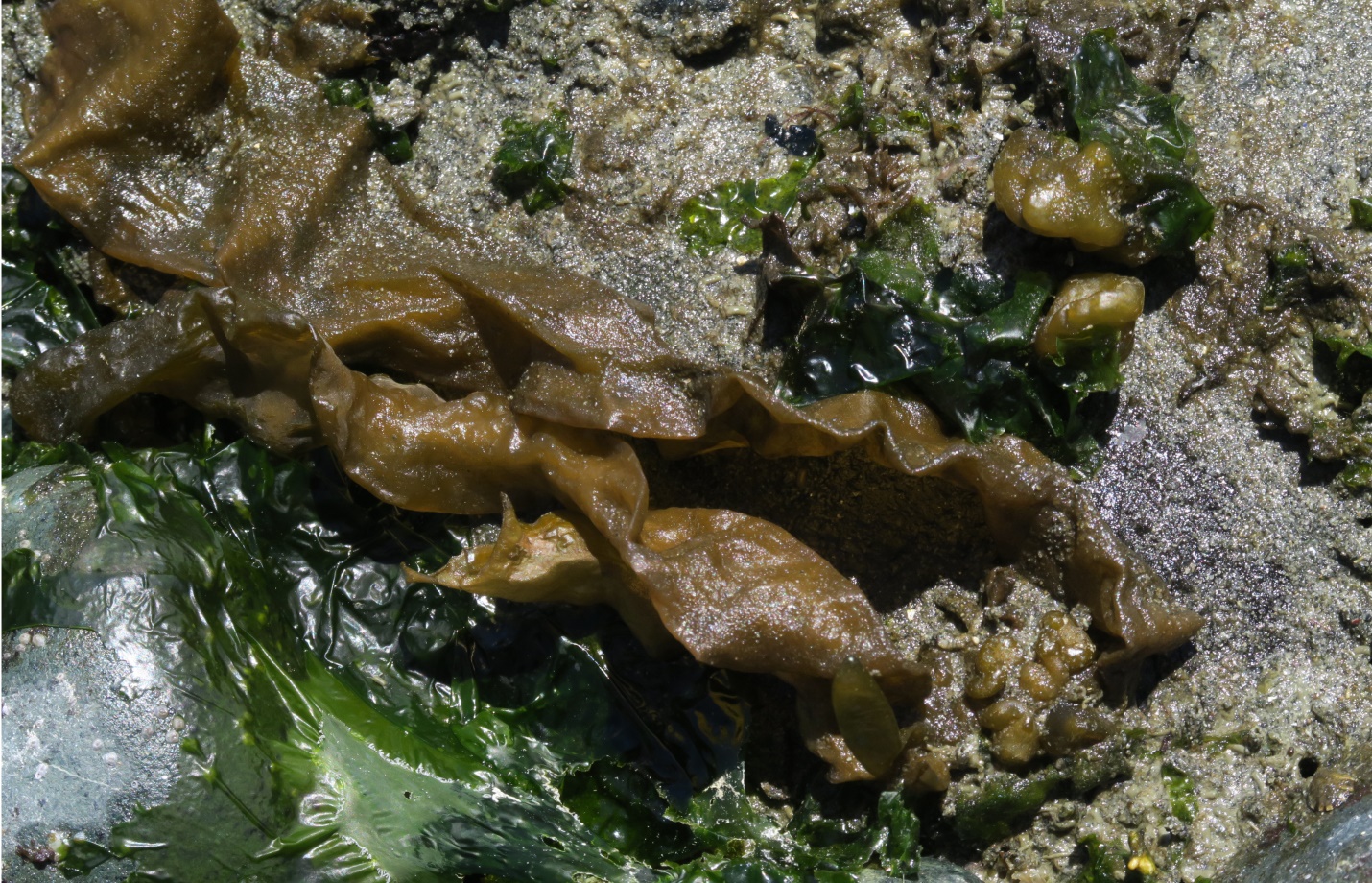
Figure 7: Two Dactylosiphon bullosus thalli are pictured here with their lumpy holdfast area visible in the lower right corner between the bases of the two blades. A couple of Leathesia marina seaweeds and some brighter green Ulva fenestrata are some of sea rubber’s algal neighbors in this area. Willow Point North, Discovery Passage (south end), B.C., Canada. May 17, 2026. Photo ID 27875 ©Seaweedwhisperings.com
